
loading...

Athletics: Track and Field Events

Athletics is a captivating group of sports that encompasses a wide variety of disciplines. From sprints to marathons, jumps to throws, and heptathlons to decathlons, athletics showcases the remarkable abilities of athletes. Let’s explore some of the key track and field events featured at the Olympics

  • Sprints (100m, 200m, 400m):

    • These eye-catching events involve a dash to the finish line over varying distances.
    • Eight runners, each in a separate lane, sprint to victory once the starting gun sounds.
  • Hurdles (110m, 400m):

    • Similar to sprints, but with an added challenge: runners must leap over hurdles.
    • In the 110m hurdles, the hurdles are 107cm high and can be easily knocked down.
    • The 400m hurdles feature 10 evenly-spaced hurdles, with heights of 91.4cm (men) and 76.2cm (women).
  • Relays (4x100m, 4x400m):

    • Relay races involve four runners from each country, passing a baton.
    • Relay teams often include sprint specialists.
  • Middle and Long Distances (800m, 1500m, 5000m, 10000m, 3000m steeplechase):
    • Middle and long-distance runners combine sprinter-like speed with endurance.
    • In the 800m, runners complete two laps of a 400m track.
    • The 1500m involves a standing start and three and three-quarters laps.
    • The 5000m and 10000m require multiple laps, showcasing stamina.
    • The 3000m steeplechase includes barriers and a water jump.


Athletic Tracks: The Surface

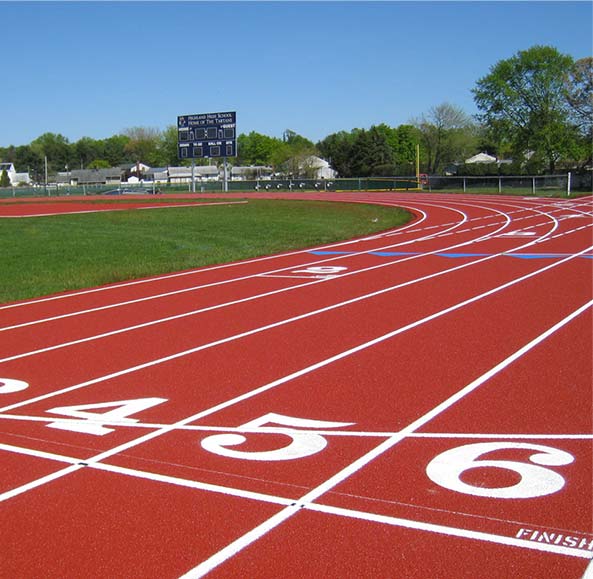
An all-weather running track is a rubberized, artificial surface designed for track and field athletics. It provides a consistent platform for athletes to test their abilities without being hindered by adverse weather conditions.
Historically, tracks were made from dirt, rocks, sand, or crushed cinders, but modern synthetic surfaces offer better performance and safety.

Here are some characteristics of athletic tracks:

  • Rubberized Material: The track surface is made of rubber, which provides excellent shock absorption and energy return.
  • Consistent Texture: Athletes can rely on a uniform texture, regardless of weather conditions.
  • Lane Markings: White lines separate the lanes, ensuring fair competition.
  • Oval Shape: The track resembles an oval, allowing for various race distances.
  • Red Color: Most tracks are red, but other colors are also used.